Translate this blog


Stitch Worksheets: 

There are free sample worksheets. Modules 5 and 6 have been published. Details can be found under the Stitch Worksheets tab 

Free weekly challenge TAST 2012:

I am running a free weekly challenge. Details are here

All posts relating to this challenge are in the one category Take a Stitch Tuesday


Thanks for the logo goes to Annet of Fat Quarter. Annet has kindly allowed the use of her image.

Next online class:

Studio Journals a Designers Workhorse will commence on Feb 9th is nearly full. If you are interested signups are about to close.  Follow the link for full details and requirements.  If you are curious how online classes run you will find a description is on the Classes page

Newsletter

Sharon B's Stitching News is an announcement only newsletter used to let people know about challenges, community events, classes and really, really good stuff! It is used for announcements only not chat. 

Christmas Labels

Recent Comments

What is here?

Resources

Stitch Dictionary : An illustrated step by step stitch guide for hand embroiderers. 

12 Surface Stitches for Beginners is a illustrated stitch guide (PDF file).

Free patterns

See the Friday Freebie section as you will find many free resources 

Eye Candy 

My latest work in progress is the Lace crazy quilt

Diamond Block crazy quilt section

Crazy quilt details is a series documenting the I dropped the button box a crazy quilt

If you like embroidery see the For Love of Stitching Band Sampler which is being photographed and blogged band by band in a series or articles.

Tutorials 

How to stitch Freestyle woven bars.

How to stitch a needle woven picot

How to work closed needlewoven picot leaf stitch

How to make a Five point ribbon flower

How to stitch a silk ribbon Farago Rose

How to use transfer dyes to print on synthetic fabric.

How to Transfer Embroidery Patterns to Fabric

How to make Ric-rac Roses

How to work Shisha Stitch

Adding pages to a wire bound journal

Tips and FAQs

Tips for working Bullion Stitch

Tips for using Chenille thread

What is Ribbon Floss?


Contact
This form does not yet contain any fields.

    I regularly offer online classes in areas of design, hand embroidery and crazy quilting.

    I limit the number of student in my classes. If you are interested in a class not currently on offer please contact me to go on a waiting list.

    This is how they work online.  

    All my classes are 6 weeks long and there is a lesson per week. 

    There are two major components of online classes, the lessons themselves, and the discussion list which is a Yahoo email group. When you buy the class you will be invited to join the group.  

    The lessons are the guts of the class. The first lesson will be released on the start date of the class and a lesson per week is released after that. The lessons are an Adobe PDF document which are held in the files area of the Yahoo group. Students download the file, print it out and work through the lesson and use the discussion group to ask questions.   

    There is a one lesson per week. I have designed all my lessons so that people can work at them as much or as little as they choose. Some people have more time to put into them others do not. I understand this, for this reason they are self paced.

    The yahoo email group is where all class communication takes place. Since students are from all around the globe time zones do not allow real time chat but you can post messages which will be delivered as email to all class members.

    The advantage to using a yahoo group is that all the class discussion can be delivered to your email box. Not only that but students have a choice about how they want their class discussion to be delivered. Students can receive all class chat by email single message at a time, or they can set their membership to to Daily Digest and receive it all in one message each day. Or if students dont want all this chatter in their email they can elect to set their group membership to web only viewing. This means they can visit the yahoo class group website to read the messages. 

    I check the class discussion daily and answer questions, join in on the chat and we generally have a good time.

    Students can upload images of their work online in the photo area of the yahoo class group, so I can give them feedback. Participation in the email discussion is totally voluntary but I think this is the fun part of the process as it is where students get feed back from me, bounce ideas off each other and share the pleasure in learning a new skill.

    Classes are paid for by Paypal and are priced in US dollars. 

    If you have questions email me via the contact button on the top menu bar. 

    Scroll down to see what is on offer.

    Friday
    Nov182011

    Studio Journals: A Designer’s Workhorse starting February 9th

    Bookings for this class is closed as it is now full

    Keeping a Studio journal is a process for catching ideas and developing them into designs that can be realised in fiber. Unlike an Art journal which aims to be an aesthetic object in its own right a Studio journal is a designers workhorse. Many people confuse the two!

    In all fields notebooks are starting points for more developed ideas. Painters keep a sketchbook to take visual notes of what they see but their finished paintings and their sketches are very different. Writers keep notebooks but their published book is not the same as what is first put down on paper.  Both writers and painters go through a process using their sketches and notes as a starting point. Fiber artists do the same thing noting ideas and developing designs.  This is what this course is about.

    This course covers the process of using a Studio journal to create designs suitable for textiles such as contemporary embroidery, or quilting but not making those pieces up.

    The aim is to develop the habit of using a  Studio journal as part of your creative practice.

    You do not have to know how to draw.

    This workshop covers the process of how to keep a studio journal, how to develop and idea further, and how to turn it into a design suitable for a project in fiber.

    Each week a series of design exercises are introduced. Students work though these in order to develop designs that can be applied to fiber. They aim to develop design skills and the habit of using a studio journal.

    Please note that this course is not about creating an art journal that is a finished object in its own right. The emphasis is very much on using a studio journal as part of a design process to produce something in fiber. The course contains design exercises and techniques and discusses how these might be applied to textiles. It is a course where students spend their time designing for textiles and working in their Studio Journal rather than working a step by step project. That said I am definitely not going to discourage anyone from jumping in and making something! 

    Supplies for Studio Journal Course

    • Sketchbook to use as a studio journal
    • A digital camera and knowing how to use it at a basic level
    • Pencils 2B, 4B, 6B
    • A mix of pens for writing and sketching
    • Soft art eraser
    • Small bottle of PVA glue
    • Brush for glue
    • Glue stick
    • 1 jar of Gesso
    • Artists brushes  
    • Lots of old magazines to chop up
    • Coloured and interesting scraps of paper
    • Tracing paper (to trace off designs)
    • Ruler
    • Scissors for paper
    • Scissors for fabric
    • Knife with retractable blade.
    • Masking tape
    • Double sided sticky tape
    • A quarter of a yard of Misty Fuse
    • Small pieces of scrap fabrics, scrap thread, scrap wool
    • Watercolour paints (a basic set will be fine)
    • Water colour brushes
    • Sponge
    • Drawing supplies you may have on hand such as coloured pencils, oil crayons etc

     What sort of Journal should I buy? 

    I recommend a notebook with sturdy cartridge paper or drawing paper in other words an artists sketchbook as the paper in these books are designed to take a number of different wet and dry art materials. If the paper is strong enough you have no problems with what is done in between the pages. You can glue things in, attach fabric swatches, threads, and the like and the paper is strong enough to take it. 

    When you purchase a sketchbook think about the size. Do you want something that you can pop into a handbag? Or do you want to treat yourself to lovely bound journal? If you feel a visual journal is daunting or pretentious buy a small one. You don't want to buy something that is so large and imposing you’re fearful of using it! If on the other hand you want to treat yourself use this as an excuse!

    Both bound and spiral journals have advantages and disadvantages. It's up to you and the way you think you might work to decide on what might work best for your taste.

    Spiral bound journals allow you to have the book open flat while you work and allow for expansion but the pages can rub.

    Bound journals do not rub and damage pages in the same way and I have found can take more hard wear and tear but they do not expand as much. A good bound journal should open right up and lie flat too. If it does not you are looking at a trendy fashion notebook which is possibly not the best choice. 

    How are classes Run?

    If you want to know how online classes run a description is on the Classes page. Dont hesitate to contact me about the class if you have more questions. 

    Special Important stuff please read before you buy. 

    I only accept Pay Pal.

    Please make sure your paypal email address is correct as that is the one I will use. 

    If you want me to use another email address please tell me!

    Please make sure my email is not blocked by your spam filter (sharon dot boggon at gmail dot com) 

    Read how online classes run a description is on the Classes page.  

    Please note once the classes have started and you have downloaded the lessons there is no refund on a digtal product. 

    When I receive your order I will respond within 48 hours. If you do not hear from me something has gone haywire, check your spam box and make sure you haven’t tossed me out, and my email is not there please contact me so we can sort it before the class starts.

    Price

    $60.00 US for 6 lessons 

    Sorry class is now full

    Start Date 

    February 9th 2012

    To secure a place in the class

    Once the class is purchased you have a place. It it that simple.


    Wednesday
    Aug312011

    Encrusted Crazy Quilting October 12, 2011 start date

    Added later Class is now full and closed

    Encrusted Crazy Quilting offers students the opportunity to learn how to piece, develop and heavily hand embellish a crazy quilt block with hand embroidery, beading and exploring different embellishing techniques while solving design, composition and colour issues.

    This class is suitable for beginners to intermediate crazy quilters.

    Course Outline

    In this 6 week course and I cover fabric selection and block assembly in process discuss colour and applying basic composition tricks to a crazy quilt block. Building on basic hand stitching techniques, developing combination stitches is covered. Motif selection, size, balance and placement is discussed. Different possible hand embroidery techniques and treatments such as silk ribbon embroidery and using textured stitches are introduced.

    How the eye on a journey by using composition and design elements and building up visual texture. Working with lace, ribbons and braids and building up texture working with buttons and beads. 

    If you want to know how online classes run a description is on the Classes page. Don't hesitate to contact me about the class if you have more questions. 

    Class Requirements 

    • Lessons are in PDF format and you will need Adobe reader to view them. The PDF reader is free from Adobe
    • You need to be able to join and access the yahoo class group 
    • You need to be able to down load files of up to 10 megs from the class area

    Crazy quilting needs 

    • Transdoodle ( it is like a stitchers carbon paper you will find a demonstration of its use and full description of what it is here )  
    • Rotary cutter, ruler and cutting mat.
    • A sewing machine used to piece the block all other stitching is hand work.
    • Prewashed calico (Muslin in the USA) 15 inches by 15 inches
    • A mix of fabric scraps a mix of 10 to 15 pieces approx 6 x 8 inches in size from after 5 wear such as glitzy fabrics, synthetics, satin, or rayon velvet, taffeta silks, brocades, metallic fabrics etc Avoid heavy weight fabrics such as thick velvet, upholstery weight tapestries, heavy corduroy, and heavily waxed cottons.
    • Scraps of ribbon, fine trims, scraps of cotton lace, that will sit with your fabrics well, no need for anything longer than 8 inches.
    • Assorted seed beads, bugle beads and a selection of assorted small novelty beads that are co-ordinated to go with your fabrics. Nymo or Silamide beading thread. Beading needles if you require them.
    • Dig into you button box and find buttons that look interesting.
    • A selection of hand embroidery threads, in fine and medium weights, such as fine silk, pearl cottons, novelty and textured yarns in colours that will sit with your fabrics.
    • A selection of Silk ribbon in 2mm, 4mm, 7 mm and 13mm widths in colours that do not clash with the fabrics you have chosen.
    • A packet of crewel needles in mixed sizes
    • Milliners needles in mixed sizes also in mixed sizes
    • Beading needles
    • Mixed packet of tapestry needles
    • Mixed packet of chenille needles (for silk ribbon).
    • Notebook, ruler, and quilters marking pencil that is easily removed from your block.
    • Regular sewing equipment 
    • Embroidery hoop 

    Price 

    $60.00 US for 6 lessons 

    Start Date 

    October 12th, 2011


    Special Important stuff please read before you buy. 

    I only accept Pay Pal.

    Please make sure your paypal email address is correct. 

    Please make sure my email is not blocked by your spam filter (sharon dot boggon at gmail dot com) 

    Read how online classes run a description is on the Classes page.  

    Please note once the classes have started and you have downloaded the lessons there is no refund on a digtal product.


    When I receive your order I will respond within 48 hours. If you do not hear from me something has gone haywire, check your spam box and make sure you haven’t tossed me out, and my email is not there please contact me so we can sort it before the class starts.

    Wednesday
    Jun152011

    Sumptuous Surface Embroidery on offer to start 27th of July 

    This class is now SOLD OUT and fully booked.

    If you are interested in taking this online class I can add you to the the waiting list for the next time it is run (probably early next year). Just contact me via the contact tab.

      * * * * * * * * *  

    Sumptuous surfaces explores the wonders of highly textured free form contemporary hand embroidery while also developing design skills.

    Over a six week period students are guided through the design process as well as techniques used in free form textured hand embroidery.

    Students are encouraged to create their own design and make two or three small hand embroidered panels. I suggest students work on fabric postcards as this size is ideal to work as a small design exercise. However if people want to work larger it is their choice.

    If you are hesitant about designing your own projects, students are offered the choice of a number patterns to either directly follow, use as a jumping off point, or see how a design is developed. Those more experienced stitchers are actively encouraged to jump in and design their own piece. This means the course is suitable for beginners to advanced stitchers as you can work at your own skill level.

    Working in Monotone and Colour

    The course is divided into 2 blocks of 3 weeks each.

    The first section of the course deals with designing highly textured pieces in monotone.

    The second section of the course builds on that knowledge and students design and work a piece using colour.

    Throughout the six week course key concepts in design are covered such as, composition, shape, geometrical and organic shape, space, handling positive and negative space, scale, density, weight, line, movement, direction and texture.

    Throughout the course I have focused intensely on texture as design element. Understanding texture is key in the textile arts. An area of interest can be created because it is heavily textured, complex and intricate. Texture is also the element that separates textiles from arts such as drawing or painting. In both drawing and painting texture is represented whereas in textiles we have the option of representing texture or actually working the physicality of texture. In other words the surface can be manipulated in a physical way not just represented. This aspect of textiles sets it apart as a medium.

    All my courses are written to be used long after the course is finished. I understand that sometimes life gets in the way and some students are not able to stitch along in the 6 week period. For anyone who finds themselves in this position the teaching material provided will enable you to work through the ideas in a self paced manner.

    Course Outline

    Weeks 1-3
    The first week is an introduction to the design process. The same basic process is used to design everything. This process is often described in three steps, Concept, Form and Content. Key principals of design are covered in order to develop a design for a monotone piece of embroidery. I cover where to look for design ideas and how to develop them using composition, shape, geometrical and organic shape, space, handling positive and negative space, scale, density, weight, line, movement, direction and texture.

    In weeks two and three we deal with techniques that can bring your project to fruition. In these two weeks we look at the nuts and bolts of stitching, thread choice, working with textured stitching, found objects and beads.

    Weeks 4, 5 and 6
    Colour is a huge topic so I have devoted a week to it. In week 4 once again we return to the design process and work up a design in colour. Once again we are exploring ideas on paper or in a visual journal only this time we are dealing with colour principals and design combined. New designs are explored and worked up with an eye to creating them over the final two weeks.

    In these last two weeks you give form to your concept. In this time block you learn to handle colour as well as combining the skills learnt in the first section of the course. 

    Some students may wish to simply treat everything made in this course as design exercises. That is fine. Other students may wish to tackle other subjects. This is also fine as I actively encourage all students to learn and develop in their own manner and it makes for an interesting class!

    Requirements List:

    At least 2 pieces of 26 or 28 count even weave linen in cream, off white or antique white each measuring 9 x 9 inches

    Threads:

    In weeks 1-3 you will need a selection of threads in one colour range in order to work in monotone.

    I have found working in cream, white, bone and natural muted tones in this time block to be an advantage to most students. This is just a suggestion, it is not necessary. If students want to work in another colour they are free to do so. Whatever the colour, you will need  perle threads in sizes 5, 8, and 12. I also suggest a good selection of hand embroidery threads, in fine and medium weights, such as silk threads, rayon ribbon floss,  crewel wool yarns,  and Coton a Broder.

    Please note I have said "selection of threads". There is no need to go to great expense buying every thread listed but you need a variety of threads that have different textures, thickness and sheen. It's the contrast that is important and I am trying to get new stitchers away from using just stranded cotton.  You will definitely need a range of colours in DMC perle threads in sizes 5, 8, and 12   

    For the second section of the course you will need a selection of coloured hand embroidery threads, in fine and medium weights, such as perle cottons, silk threads, rayon ribbon floss, overdyed and hand dyed threads (Caron Watercolors, and Caron Waterlillies are ideal), crewel wool yarns, and Coton a Broder. Thicker threads for couching to the surface of the fabric are also used. Once again you do not need every thread on this list just a small range will be suitable.

    A selection of beads such as seed beads, bugle beads, round and ring spacer beads between 5mm and 20 mm. Interesting feature beads that are between 10 – 25 mm in size and have a large hole in the middle are useful. Have some heishi or hishi beads to hand. Small round, dome shaped bead caps are useful. 

    In highly textured embroidery beads of of all sorts are fun to use. There is a wide range to choose from. Materials of wood, bone, shell, clay, soapstone, beads made of seed pods, coconut shell, and stone lend themselves to being incorporated in these projects. Items like sliced shells larger donut beads, bead disks and donuts are wonderful to include in this type of project.

    Needles:

    Chenille Needles (size 22 – 26)

    Tapestry Needles (size 20 - 26)

    Embroidery/Crewel Needle (size 7-10)

    Milliners/Straw Needle (size 3-9)

    Beading needles

    Other:

    Usual hand sewing equipment such as embroiderers hoop, scissors etc. 

    Notebook, visual journal or folder in which to keep design exercises, ruler, and quilters marking pencil that is easily removed from your work, dress makers carbon, tracing paper.

    If you want to know how online classes run a description is on the Classes page. Dont hesitate to contact me about the class if you have more questions. 

    Price 

    $60.00 US for 6 lessons 

    Start Date 

    27th of July

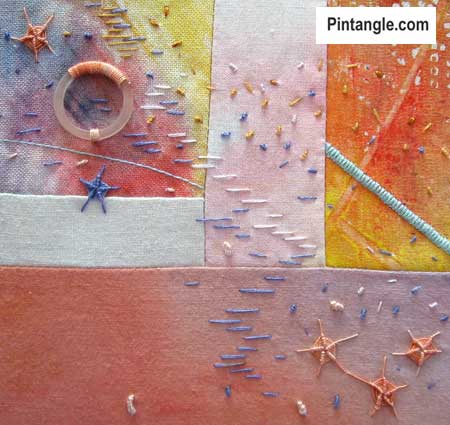
    image of hand embroidery

    If you are interested in this class in the future please contact me as I limit the number of student in a class and keep a waiting list. You may want to join my announcement only newsletter  Sharon B's Stitching News is used to let people know about challenges, community events, classes and really, really good stuff! 

    Once you receive notification that the class is available to secure a place in the class simply buy it and just before the start date you will receive an invitation to class group and instructions on where you can down load the first lesson.

    A notice to students

    For anyone who has taken one of my classes please feel free to leave a comment so that people who are thinking of taking a class can read what you thought of them.

    Wednesday
    Dec082010

    GIMP for Textile Designers

    Learn design techniques that are used by textile and fiber artists and how to use a graphics program at the same time! 

    GIMP is an open source FREE program that can be used to manipulate, retouch and edit photos. It can also be used as a design tool. 

    GIMP has many capabilities. GIMP is often compared to Photoshop as it can be used to edit and retouch photos, be a paint program and much more. This workshop while touching on these uses, has a main focus of using the program as a tool to develop designs that can be applied to fiber and textiles. In other words, GIMP for Textile Designers is Graphics program course written expressly for people who quilt, embroider and express themselves via fiber.


    This workshop is aimed at people interested in developing their own designs using a computer graphics program. Gimp for Textile Designers offers a series of exercises that allow students to develop their design skills while also teaching learning how to use GIMP.


    Please read course requirements: The course assumes that students have no knowledge what so ever of GIMP itself but I do assume students have basic computer skills. I am perfectly happy to answer dozens of questions and help you to use GIMP but I can not, and do not know the in and outs of every computer system on this planet. 

    Students coming to this course need basic computer skills by which I mean being able to open and save a file to a destination where it can be found again (not get it lost on your hard drive). To be able to save a duplicate copy of a file. Understanding the importance of backing up your work and actually doing it! Students need to be able to take, and then download images from a digital camera to your computer. They need to know how to use their own digital camera (once again I do not know the ins and outs of every camera available on the market) I will also expect students to be able to use the internet, visit websites and use internet resources if required. Students need to be able to install a program on their own computer. 

    In other words all that gruff stern stuff, is saying I can teach you GIMP but not how to use your own computer. I can also teach you GIMP in a manner that will interest people who want to design, rather than simply taking you through screen after screen of tech stuff which lets face it is boring. I can show you how to use GIMP in a way that relates to textile designers without getting bogged down in information that is not applied in textile practice.  

    Please read
    Prospective students must be able to download and install this program themselves. Since the program itself is totally free I suggest that prospective students install and launch GIMP before they sign up for this course. If you are unable to follow installation instructions on the site you will not be able to follow instructions in this course. 

    There are versions of GIMP for both Mac and PC. GIMP is free. To obtain the program go to gimp.org and download the latest stable version of the program.

    If you want to know how online classes run a description is on the Classes page. Dont hesitate to contact me about the class if you have more questions. 

    Price 

    $60.00 US for 6 lessons 

    Start Date 

    TBA

    If you are interested in this class in the future please contact me as I limit the number of student in a class and keep a waitng list. You may want to join my announcement only newsletter  Sharon B's Stitching News is used to let people know about challenges, community events, classes and really, really good stuff!  

    To secure a place in the class simply buy it, and just before the start date you will receive an invitation to class group and instructions on where you can down load the first lesson.

    Please note once the classes have started and you have downloaded the lessons there is no refund on a digtal product. 

    Tuesday
    Dec072010

    Studio Journals: A Designer’s Workhorse

    Keeping a Studio journal is a process for catching ideas, developing those ideas into designs with the aim of realising those designs in fiber. Unlike an Art journal which aims to be an aesthetic object in its own right a Studio journal is a designers workhorse. Many people confuse the two!

    This course covers the process of using a Studio journal to create designs suitable for textiles such as contemporary embroidery, or quilting but not making those pieces up. To use a Studio journal as part of your creative practice you do not have to know how to draw but there are some tricks to establishing a process that leads to a design that can be applied to textiles. This workshop covers the process of how to keep a studio journal, how to develop and idea further, and how to turn it into a design suitable for a project in fiber. Painters keep a sketchbook to take visual notes of what they see but their finished paintings and their sketches are very different. Writers keep notebooks but their published book is not the same as what is first put down. Notebooks are starting points for more developed ideas. Both writers and painters go through a process using their sketches and notes as a starting point. Fiber artists do the same thing when they develop a design. Studio journals can be used as the starting point for textile practitioners. This is what this course is about.

    Each week a series of design exercises are introduced. Students work though these in order to develop designs that can be applied to fiber. They aim to develop design skills and the habit of using a studio journal.

    Please note that this course is about keeping a studio journal as a work horse not about creating an art journal that is a finished object in its own right. The emphasis is very much on using a studio journal as part of a design process to produce something in fiber. The course contains design exercises and techniques and discusses how these might be applied to textiles. It is a course where students spend their time designing for textiles and working in their Studio Journal rather than working a step by step project. That said I am definitely not going to discourage anyone from jumping in and making something! 

    Supplies for Studio Journal Course


    • Sketchbook to use as a studio journal
    • A digital camera and knowing how to use it at a basic level
    • Pencils 2B, 4B, 6B
    • A mix of pens for writing and sketching
    • Soft art eraser
    • Small bottle of PVA glue
    • Brush for glue
    • Glue stick
    • 1 jar of Gesso
    • Artists brushes  
    • Lots of old magazines to chop up
    • Coloured and interesting scraps of paper
    • Tracing paper (to trace off designs)
    • Ruler
    • Scissors for paper
    • Scissors for fabric
    • Knife with retractable blade.
    • Masking tape
    • Double sided sticky tape
    • A quarter of a yard of light weight iron-on non woven interfacing
    • A quarter of a yard of Misty Fuse
    • Small pieces of scrap fabrics, scrap thread, scrap wool
    • Watercolour paints (a basic set will be fine)
    • Water colour brushes
    • Sponge
    • Drawing supplies you may have on hand such as coloured pencils, oil crayons etc


    I recommend a notebook with sturdy cartridge paper or drawing paper in other words an artists sketchbook as the paper in these books are designed to take a number of different wet and dry art materials. If the paper is strong enough you have no problems with what is done in between the pages. You can glue things in, attach fabric swatches, threads, and the like and the paper is strong enough to take it. 

    When you purchase a sketchbook think about the size. Do you want something that you can pop into a handbag? Or do you want to treat yourself to lovely bound journal? If you feel a visual journal is daunting or pretentious buy a small one. You don't want to buy something that is so large and imposing you’re fearful of using it!

    Spiral bound journals allow you to have the book open flat while you work and allow for some expansion but the pages can rub. Bound journals do not rub and damage pages in the same way and I have found can take more hard wear and tear but they do not expand as much. A good bound journal should open right up and lie flat too. If it does not you are looking at a trendy fashion notebook which is possibly not the best choice. Both bound and spiral journals have advantages and disadvantages. It's up to you and the way you think you might work to decide on what might work best for your taste.

    How are classes Run?

    If you want to know how online classes run a description is on the Classes page. Dont hesitate to contact me about the class if you have more questions. 

    Price

    $60.00 US for 6 lessons 

    Start Date 

    TBA

    If you are interested in this class in the future please contact me as I limit the number of student in a class and I keep a waitng list.

    You may want to join my announcement only newsletter  Sharon B's Stitching News is used to let people know about challenges, community events, classes and really, really good stuff! 

    Once you receive notification that the class is available to secure a place in the class simply buy it and just before the start date you will receive an invitation to class group and instructions on where you can down load the first lesson.

    Please note once the classes have started and you have downloaded the lessons there is no refund on a digtal product.

    A notice to students
    For anyone who has taken one of my classes please feel free to leave a comment so that people who are thinking of taking a class can read what you thought of them.